
Four Hills Tournament 2026/27: Schedule and Prize Money
The 2026/27 Four Hills Tournament runs from 28 December to 6 January. It starts in Oberstdorf and finishes in Bischofshofen. For the first time, the women have their own four-event tournament alongside the men at all four hills.
When is the 2026/27 Four Hills Tournament?
The first men’s competition is on 29 December. The women open a day earlier, before the first men’s qualifying round. The tables give the start times for qualifying and the first round of competition from the organiser’s provisional programme.
| Venue | Hill | Qualifying | Competition |
|---|---|---|---|
| Oberstdorf | Schattenbergschanze (HS 137) | ||
| Garmisch-Partenkirchen | Große Olympiaschanze (HS 142) | ||
| Innsbruck | Bergisel (HS 128) | ||
| Bischofshofen | Paul-Außerleitner-Schanze (HS 142) |
When are the women’s events?
The women qualify and compete on the same day at each venue. Their tournament finishes a day before the men’s. All times in both tables are local to the venues and Poland (CET).
| Venue | Hill | Qualifying | Competition |
|---|---|---|---|
| Oberstdorf | Schattenbergschanze (HS 137) | ||
| Garmisch-Partenkirchen | Große Olympiaschanze (HS 142) | ||
| Innsbruck | Bergisel (HS 128) | ||
| Bischofshofen | Paul-Außerleitner-Schanze (HS 142) |
The first two hills are in Germany and the last two in Austria. At Garmisch-Partenkirchen the men keep their New Year’s Day slot. The women compete there on New Year’s Eve.
Hill size, shown as HS, helps put distances in context. The Bergisel has the smallest HS of the four.
A 130-metre jump goes beyond hill size there, while it falls 12 metres short in Garmisch-Partenkirchen. Keep that difference in mind when comparing distances from two venues.
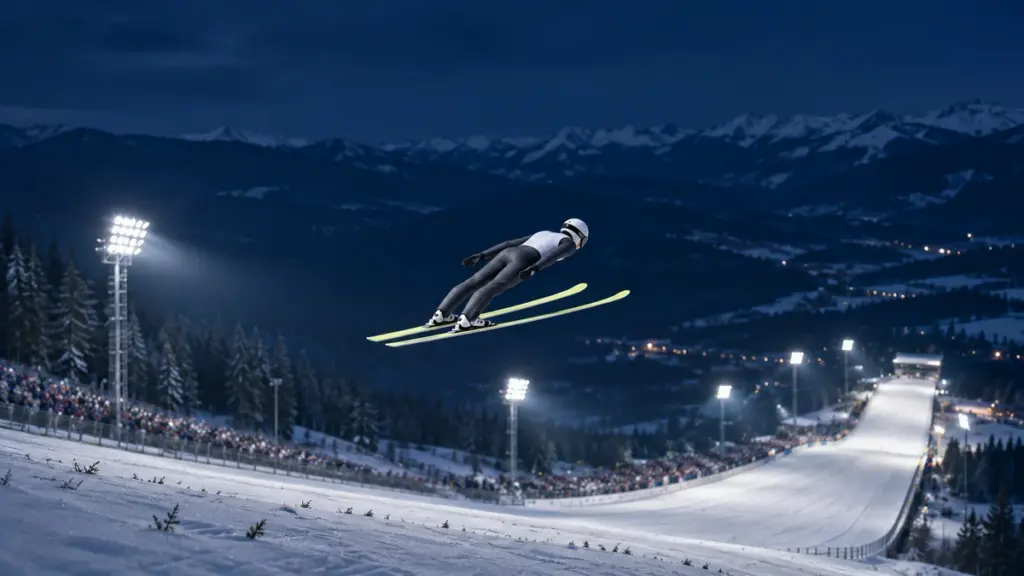
The opening ceremony is in Oberstdorf’s Kurpark at 19:00 on 27 December. Innsbruck’s new lights allow the organisers to schedule the Bergisel competition after dark for the first time. All four venues now have floodlights.
The announced women’s qualifying field has 40 places, with ten eliminated at that stage. At each stop, the men have a trial round at 15:00 on competition day. Look for the first competition round in the listings if you want to start with the jumps that count.
How is the Four Hills Tournament scored?
In a full tournament, the Golden Eagle goes to the jumper with the highest total from eight competition jumps. Each of the four events gives finalists two jumps. Qualifying scores decide who gets into the competition and how the first-round pairs are drawn.
A jump earns points for distance and style, with adjustments for wind and the starting gate. The K-point is the reference for distance. A jumper who lands exactly at the K-point gets 60 distance points.
On a large hill with a K-point between 100 and 134 metres, each metre is worth 1.8 points. Two metres beyond K earns 63.6 distance points. Two metres short earns 56.4.
Five judges mark style. The highest and lowest marks are dropped, leaving three to count. For example, marks of 18.0, 18.0, 18.5, 18.5 and 19.0 give a style score of 55.0.
A headwind carries a deduction, while a tailwind adds points. A shorter run-up adds points and a longer one takes them away. Two jumpers can land at the same spot, earn the same style marks and finish with different totals.
Judges keep watching after the skis touch down. A telemark landing puts one foot ahead of the other, with bent knees and parallel skis. A flat landing with the feet level costs at least three points from each judge.
The jury can adjust the length of the run-up during a round. A coach can also request a shorter run-up for their own athlete. In that case, the athlete must reach at least 95 percent of hill size to collect the gate adjustment.
On an HS 142 hill, 95 percent comes to 134.9 metres. A jump of 134 metres from a gate lowered at the coach’s request earns no bonus for that move. Notice who asked to lower the gate when you compare the scores.
How do the knockout pairs work?
The men’s qualifying round selects 50 jumpers. First faces 50th, second faces 49th, and the jumpers in 25th and 26th open the competition. The 25 duel winners advance, along with the five highest-scoring jumpers who lost their duels.
The women’s knockout field has 30 athletes. The qualifiers ranked first and 30th meet, while 16th faces 15th in the opening pairing. The 15 winners go through with the five highest-scoring losers.
A jumper who loses a duel has to wait for the other pairs. A good score secures a place in the final only if it stays among the five best losing scores. That makes the lucky-loser list worth following as the last pairs jump.
The second round is an individual round. Jumpers go in reverse order of their first-round scores. Both jumps count towards the event result, including the first jump of an athlete who got through as a lucky loser.
How does the tournament standings system differ from the World Cup?
A World Cup event win puts 100 points towards the season standings. Second place earns 80 and third earns 60. In the Four Hills standings, every tenth of a point from the actual competition scores carries over.
Imagine two jumpers scoring 280 and 277 at Oberstdorf. At the next hill they score 267 and 272, respectively. The first jumper now has 547 points.
The other has 549. The two-point gap goes with them to the next hill.
Missing a final costs a whole scoring jump. On a full schedule, an athlete chasing the title needs to make every final.
Qualifying is about securing a good pairing. Round one is about earning another jump that counts.
A tenth of a point can matter, and ties do happen. In 2005/06, Janne Ahonen and Jakub Janda both reached 1,081.5 after eight jumps. They shared the tournament title.
What is the prize money for the 2026/27 Four Hills Tournament?
The organiser announced a record €697,200 in prize money for the 75th edition, covering the men’s and women’s events. The first women’s overall champion receives a €30,000 victory bonus. She also gets a Golden Eagle and keeps any money earned at the four World Cup competitions.
The FIS World Cup rules specify a minimum of €100,250 for the top 30 in an individual men’s event. The podium places pay €15,000, €11,500 and €9,000.
The standard women’s table sets aside €35,200 for the top 25 in an individual event. The first three receive €5,000, €4,000 and €3,000.
Two Golden Eagles are up for grabs this season. Each trophy weighs 8.8 kg.
Who is on Poland’s ski jumping team for 2026/27?
The Polish Ski Association lists six men and four women on its national A teams for the season. The FIS start lists show who is entered at each Four Hills event.
- Men: Kacper Tomasiak, Klemens Joniak, Paweł Wąsek, Piotr Żyła, Maciej Kot and Dawid Kubacki. Maciej Maciusiak is head coach.
- Women: Anna Twardosz, Pola Bełtowska, Kamila Karpiel and Natalia Słowik. Marcin Bachleda leads the team.
Which Polish jumpers have won the Four Hills Tournament?
Polish men earned nine overall podium places through the 2025/26 edition. Three different jumpers accounted for five wins.
The table records final tournament standings. When two Polish names appear in one edition, both reached that edition’s overall podium.
| Season | Jumper | Place |
|---|---|---|
| 2000/01 | Adam Małysz | 1 |
| 2002/03 | Adam Małysz | 3 |
| 2016/17 | Kamil Stoch | 1 |
| 2016/17 | Piotr Żyła | 2 |
| 2017/18 | Kamil Stoch | 1 |
| 2019/20 | Dawid Kubacki | 1 |
| 2020/21 | Kamil Stoch | 1 |
| 2020/21 | Dawid Kubacki | 3 |
| 2022/23 | Dawid Kubacki | 2 |
Adam Małysz scored 1,045.9 points in 2000/01. He finished 104.4 ahead of Janne Ahonen, the largest winning margin recorded by the organiser. Małysz also became the first jumper to pass 1,000 points in the tournament.
Kamil Stoch completed a sweep in 2017/18, winning at each of the four hills. Sven Hannawald was the first to do it, in 2001/02. Ryōyū Kobayashi matched Stoch a year later.
Dawid Kubacki clinched the 2019/20 title by winning the final at Bischofshofen. He set the top score in round one and the overall contest went down to the last jump.
The Golden Eagle trophy dates from 2012/13, when Austria’s Gregor Schlierenzauer became the first jumper to receive it. Małysz’s title belongs to the years before the current trophy.
The 2022/23 edition shows how the two sets of standings can diverge. Kubacki won on the Bergisel.
Halvor Egner Granerud trailed by 12.8 points after round one and 3.5 after the final. Granerud held the overall lead, won the Bischofshofen final and finished the tournament 33.0 points ahead of Kubacki.
How did the Four Hills Tournament begin?
The first tournament opened on New Year’s Day 1953 in Garmisch-Partenkirchen. Norway’s Asgeir Dølplads won the opener with jumps of 78.5 and 81 metres. Oberstdorf came second on the itinerary that year.
Austria’s Sepp Bradl won in Innsbruck and finished second at the other three hills. Norway’s Halvor Næs beat him at Bischofshofen. Bradl had the best total across all four and became the first overall champion.
Weather can change the itinerary. A föhn storm in 2007/08 forced the organisers to move the Innsbruck competition to Bischofshofen. The same switch happened in January 2022.
Who should you watch at the 2026/27 Four Hills Tournament?
Kacper Tomasiak was 12th overall in 2025/26, the best Polish finisher. He ended 143.5 points behind the winner.
His final position is a good benchmark this time. A strong result at one hill tells you less about his progress than the four-hill total.
Dawid Kubacki and Piotr Żyła finished 43rd and 60th, respectively, in 2025/26. Maciej Kot was 25th and Paweł Wąsek was 35th. At Oberstdorf this time, start by counting how many of Poland’s jumpers earn a second jump.
Domen Prevc won the previous edition with 1,195.6 points. Jan Hörl finished 42.3 points behind him and Stephan Embacher 45.0 behind. The two Austrians are a natural comparison for the defending champion before the tournament moves to their home hills.
Ryōyū Kobayashi was fifth overall in that edition. The organiser credits him with eight individual event wins at the tournament. Compare his score at the opening hill with those of the previous overall podium.
Nika Prevc won her third Two Nights Tour title last season. At Oberstdorf she climbed from 17th after the first round to fourth after scoring 151.2 on her last jump.
Canada’s Abigail Strate won the event. Prevc’s recovery was enough to keep her ahead in the overall standings.
Anna Twardosz placed 18th in both Lillehammer World Cup events at the start of this season. Eirin Maria Kvandal won the first and Anna Odine Strøm the second. At Four Hills, watch Twardosz’s qualifying score, her opponent and the cutoff for a second jump.
Our view: which result tells you the most?
For the Polish men, the gap to the leader after two events is the most telling number. The organiser’s archive shows that 30 Oberstdorf winners went on to win the tournament across its first 74 editions. A second hill shows who can put together another pair of strong scores.
After Garmisch-Partenkirchen, note the gap from the top Polish jumper to the leader. At Innsbruck, check it after each round. You can see whether the gap grows steadily or traces back to a single poor jump.
The women’s move into Austria is worth watching too. Innsbruck and Bischofshofen are hosting women’s World Cup competitions for the first time.
The 2024/25 finale showed how much a single score can matter. After three events, Stefan Kraft, Jan Hörl and Daniel Tschofenig were separated by 1.3 points. Kraft led and Tschofenig sat third.
Tschofenig won the final event in Bischofshofen and took the Golden Eagle. Hörl finished second overall and Kraft third. With a gap that small after three stops, tenths of a point are worth following right down to the last jump.
Where can you follow the 2026/27 Four Hills Tournament?
The Polish Eurosport season guide lists Eurosport on TV and HBO Max and Player online. In Poland, check the broadcaster’s listings for the exact session. The broadcast and the first jump can start at different times.
Check the organiser’s programme before tuning in.
The FIS calendar links to an event page for each hill. The qualifying start list gives the jumping order. The competition start list shows when each first-round pair comes up.
For what comes next, see the 2026/27 Ski Jumping World Cup calendar. There is also a Polish-language guide to ski jumping bookmakers in Poland.
Sources: FIS calendar, FIS rules, organiser’s programme, prizes, history, 2025/26 results, Two Nights Tour, Lillehammer 21 Nov, 22 Nov, PZN, Eurosport.