
Ekstraklasa – How the Money and the League Format Work
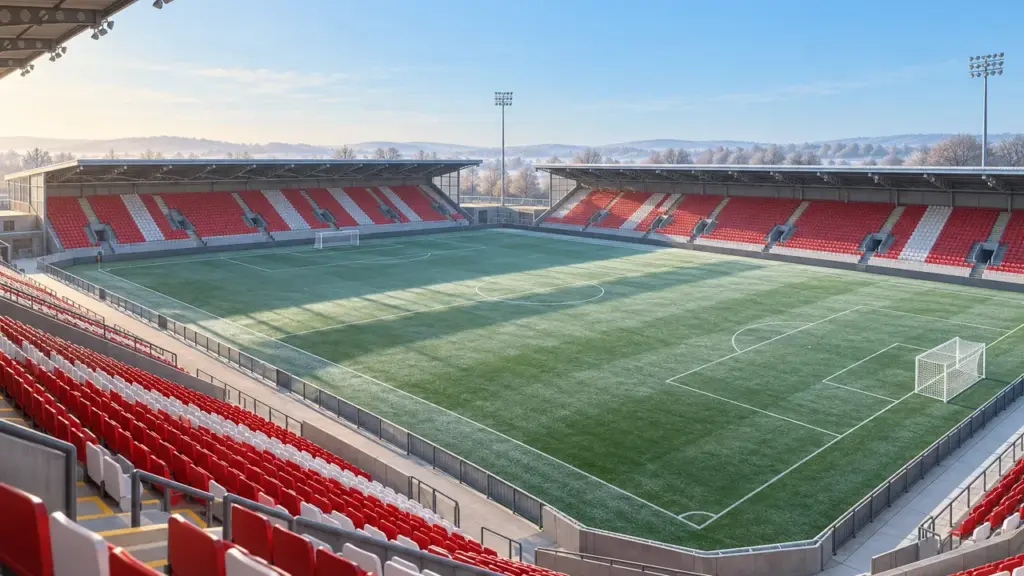
“Ekstraklasa money” and “Ekstraklasa format” are questions to which it is hard to find one decent answer – even though the Polish league has clearly described rules both for the competition and for the distribution of revenue. This text is not a guide to betting on a specific match (you will find that in our guide betting on the Ekstraklasa) – here we explain only the mechanics: how the season is built, where clubs’ money comes from and what this means for someone who bets on Polish football. Updated: November 2026.
Season format – 18 clubs, one table, 34 rounds
The Ekstraklasa is played as a double round-robin – every team plays every other home and away – with 18 teams, 34 rounds and one shared table from the first round to the last. Unlike some European leagues, the Polish Ekstraklasa does not split the season into a regular phase and a separate championship or relegation group – the whole season is played in one continuous table, and the final order after round 34 decides the champion, the European places and relegation all at once. This shape of the league has applied since the reform of the 2021/22 season, when the Ekstraklasa was enlarged from 16 to 18 clubs. Earlier, with 16 teams, the league played 30 rounds – so adding two clubs meant not only more teams at the start of the season, but also four extra rounds in the calendar, and therefore more league matches over the year.
Promotion and relegation – the exact rules
The last three places in the table after round 34 – 16th, 17th and 18th – mean direct relegation to the Fortuna 1 Liga. The Ekstraklasa has no relegation play-off for its own clubs: there is no “lifeline” known from some other leagues, and every place from 16th down is relegation with no additional matches. In the other direction the movement is three-stage: two teams from the Fortuna 1 Liga are promoted directly – the champion and the runner-up of the second tier – and the third place in the Ekstraklasa is filled by the winner of the play-offs held between the next teams from the top of the 1 Liga.
The play-off itself has a clearly defined format: four teams from places 3–6 in the Fortuna 1 Liga table take part. In the semi-finals 3rd faces 6th and 4th faces 5th, and the winners play a final for the last vacant place in the Ekstraklasa. All play-off matches are single matches – with no second leg – with the higher-placed team always at home, extra time and penalties in case of a draw after 90 minutes, and for several seasons also with the VAR system. This means that for clubs in the lower half of the Fortuna 1 Liga, the fight for 6th place alone can be as important financially as the fight for 3rd.
Season calendar – when the Ekstraklasa is played
The Ekstraklasa season has kept the same European rhythm for years: a start in the second half of summer (usually in July), a break of several weeks in winter at the turn of December and January, a return to play at the turn of January and February and a finish to the season at the end of May. This calendar shape is shared by most European football leagues – unlike, for example, North America, where league seasons coincide with the calendar year. For someone who also follows the European cups, this means that league and cup matches run in parallel through most of the autumn and spring, until the knockout stage of the Champions League, Europa League and Conference League ends in May.
Where Ekstraklasa clubs’ money comes from
The largest single source of central revenue is television rights. Canal+ has exclusive rights to broadcast all PKO BP Ekstraklasa matches under a contract worth nearly PLN 1.3 billion – the largest agreement in the history of Polish club football. The four-year, progressive contract covers the 2023/24–2026/27 seasons and gives the broadcaster rights not only to the matches themselves, but also to highlights and magazine programmes on television, on the Canal+ online service and on the internet. Under a sublicence, TVP Sport also shows one match from each round. The process of choosing a broadcaster for the next rights cycle – the 2027/28–2030/31 seasons – is already under way: Ekstraklasa S.A. officially began it in autumn 2025 and, as the head of the company said, sent invitations to bid to 30 potential partners in October 2026; the award is expected around the turn of the year.
How the pool of money is divided between the 18 clubs
The central pool of funds from marketing and television rights – about PLN 280 million in the 2024/25 season – does not go to clubs in equal parts. It is divided according to a fixed model described in advance, in which only half is an amount equal for every club, and the rest depends on sporting results, standing and work with youth:
| Part of the pool | Share | What it is paid for |
|---|---|---|
| Fixed amount | 50% | Divided equally between all 18 participants in the league, regardless of results. |
| Place in the table | 18.5% | The higher the place at the end of the season, the larger the share of this part of the pool. |
| Cups and the top of the table | 14% | An additional bonus for the three best clubs of the season and for Poland’s representatives in the European cups. |
| Historical ranking | 14% | Calculated on the basis of the club’s results over the last five seasons, not only the current one. |
| Pro Junior System | 2.5% | A bonus for regularly playing young players raised in Poland – a club may lose part of this amount if it does not meet the minutes thresholds. |
| Solidarity | 1% | An additional amount for clubs that are relegated from the Ekstraklasa in a given season. |
This model has one important consequence for someone who follows the league: even a club with no chance of the title or of Europe has a real financial reason to fight for the highest possible place in the table right up to the end of the season, because a difference of a few positions translates directly into the payout from the “place in the table” and “historical ranking” parts in the following seasons.
It is also worth distinguishing this central pool from a club’s own revenue – tickets, club sponsors, player transfers or local-government subsidies, which are not divided centrally in any way and depend solely on how a given club manages its budget. The central pool from television and marketing rights is only one – though usually significant – component of an Ekstraklasa club’s overall budget, not the whole of it.
What it means in practice – total revenue of Ekstraklasa clubs
The central pool from television and marketing rights alone is only part of the picture – only a club’s total revenue (the central pool plus tickets, sponsors, transfers and other own income) shows the real scale of money in the Polish league. The figures below come from reports in the Polish trade media (pracasport.pl and legalsport.pl, data for the 2024/25 season, accessed 2026-07-31) – they are data reported independently by two sources, consistent with each other on the values, but not audited financial statements of the clubs. The total revenue of all 18 PKO BP Ekstraklasa clubs in the 2024/25 season was about PLN 1.27 billion – an increase of about 9% compared with the 2023/24 season (about PLN 1.168 billion). Among individual clubs, Legia Warszawa ranked highest with revenue of PLN 230.9 million, ahead of Lech Poznań (PLN 145.3 million), Raków Częstochowa (PLN 142.9 million) and Jagiellonia Białystok (PLN 129.2 million).
These figures should be approached with two caveats. First, this is the revenue of the WHOLE club for the whole season (tickets, sponsors, transfers and the central pool together) – not just the bonus from the central pool described above, so they cannot be added directly to the table of the 50%/18.5%/14%/14%/2.5%/1% division above. Second, this is reporting data from the trade media, not audited financial statements of the clubs – treat them as an order of magnitude, not as accounting precision.
Editorial assessment: the gap between the top of the revenue table and the rest of the field shows something that the league table alone does not – even the third and fourth clubs on this list (Raków, Jagiellonia) have revenue of around PLN 130–145 million, that is, several times the average payout from the domestic central pool alone (PLN 280 million for 18 clubs, so on average about PLN 15.6 million per club). It is a signal that playing in the European cups and the accompanying growth in sponsorship and attendance matter for a club’s budget far beyond the domestic table alone – this is an editorial assessment resulting from comparing the figures above, not a statement of any of the cited sources.
The licensing system – two separate levels, not one
The right to play in the Ekstraklasa is not granted once and for all on the basis of sporting results alone – every season each club goes through the licensing process of the Polish Football Association (PZPN), which assesses sporting, infrastructure, staffing and administrative, legal and financial criteria. Failing to meet one of the thresholds (e.g. unsettled obligations towards other clubs or players, shortcomings in stadium infrastructure) may result in sanctions independent of the place in the table – in theory even the withdrawal of the licence, although in practice it is most often a matter of financial penalties or conditional admission to the competition.
The PZPN national licence is, however, only the first level. Playing in the European cups requires a separate, additional UEFA licence – a club that already has the right to play in the Ekstraklasa must also meet a separate UEFA licensing regulation and submit to supervision by its Licensing Administration. These are two independent processes: in theory a situation is possible in which a club meets the PZPN national criteria but does not receive the UEFA licence (e.g. for financial reasons) and, despite the place won in the table, loses the right to play in Europe in favour of the next team in the standings.
A separate part of the licensing system is the youth development programme, the so-called Młodzieżowiec 2.0 (“Youth Player 2.0”). There is no longer a rigid requirement to field a youth player in every Ekstraklasa match – instead, clubs (at the level of the Ekstraklasa and the 1st and 2nd leagues) collect points for the minutes played by eligible young players in league, cup, European and national-team matches, provided that the player plays at least 270 minutes in at least five matches in the season – only then do his minutes count towards the club’s final score.
The licensing system is also joined by VAR, used in all Ekstraklasa matches – unlike the one-off promotion play-offs from the Fortuna 1 Liga (described above), where the use of VAR is sometimes additionally emphasised precisely because these are single matches, with no second leg, in which a single wrong refereeing decision weighs more than in a typical two-leg league tie.
What this means for someone who bets on the Ekstraklasa
Since the financial difference between mid-table and the fight against relegation is real, and not only sporting, teams’ motivation at the end of the season rarely “fades” – even a team with no chance of relegation or of Europe has a reason to play for the highest possible position. This is one of the reasons why in “nothing at stake” matches in other leagues the quality of play can be lower than in the Ekstraklasa, where every place in the table is priced in zlotys. It also applies to the promotion play-offs from the Fortuna 1 Liga – a single match, with no second leg, with extra time and penalties in case of a draw, is a completely different tactical context from a typical two-leg league tie, which is worth taking into account when choosing between a market on the result after 90 minutes and the result of the match including extra time. We write more about how to turn such knowledge of the match context into a choice of market in the guide how to place bookmaker bets.
Qualifying for Europe starts with a place in the table
The Polish championship is not just a domestic trophy – it is also a ticket to the Champions League qualifiers, the most lucrative club competition in the world. The next places at the top of the table – the exact number depends on the current UEFA country ranking, described in our text about Polish clubs’ road to Europe – give entry to the Europa League or Conference League qualifiers. This means that in practice the whole upper half of the Ekstraklasa table plays for something more than just the domestic title: even a place in the top five or six can be a real chance at European money, whose scale many times exceeds the whole domestic central pool described above.
The Polish Cup – a second route to the European cups
A place in the Ekstraklasa table is not the only route to playing in Europe. The winner of the Polish Cup is guaranteed a place in the Europa League qualifiers – starting from the third qualifying round, that is, considerably later (and so against an easier opponent and closer to the league phase) than most clubs entering the European cups through the league table alone. The “league” places in the European cups then go to the next best Ekstraklasa teams – those in the top positions, right behind those qualifying for the Champions League and Europa League through the table alone. This means that for a club outside the absolute top of the league, winning the domestic cup can be a genuinely easier route to Europe than chasing a high place in the 34-round league marathon.
The European bonus as an additional incentive
A place at the top of the Ekstraklasa is not only the domestic bonus from the “cups and the top of the table” part described above – it is also a pass to the UEFA European cups, where the financial stakes are incomparably higher than the entire domestic Ekstraklasa pool put together. The exact mechanism of how much each qualifying round and the league phase of the Conference League – today the most realistic route for a Polish club to Europe – pays is described in a separate text, the Conference League: Polish clubs’ road to Europe. A general picture of how much the three European cups share out between them in total can also be found in the text money in the European cups.
How to bet on the Ekstraklasa with a licensed bookmaker
The basic markets for an Ekstraklasa match do not differ in mechanics from other leagues: 1X2, Asian handicap, the number of goals over/under a threshold or a goalscorer bet – we explain the full mechanism of each of these markets in our guides types of bookmaker bets and bookmaker handicap. What is specific to the Ekstraklasa is rather the context – the absence of a relegation play-off and the financial weight of every place in the table mean that matches in the lower half of the table can be as unpredictable as clashes for the title. You will find the full, verified list of operators holding a licence from the Minister of Finance in our list of licensed bookmakers. You can compare the offer on Polish football in our bookmaker ranking – for example the review of Forbet.
Frequently asked questions
How many teams play in the Ekstraklasa and how many rounds are there?
Eighteen clubs, in a double round-robin – every team plays every other home and away – 34 rounds in one shared table, with no split into a regular phase and a championship group. This format has applied since the reform of the 2021/22 season, which enlarged the league from 16 to 18 teams.
How many teams are relegated from the Ekstraklasa?
Three – the teams in 16th, 17th and 18th place after round 34. There is no relegation play-off for an Ekstraklasa club: every place from 16th down means direct relegation to the Fortuna 1 Liga.
How is the television money divided between the clubs?
Half of the pool goes to all 18 clubs in equal parts, and the rest depends on sporting results – place in the table, participation in the European cups, the historical ranking over the last five seasons and the youth-training programme. We describe the full percentage division earlier in this text.
Who shows Ekstraklasa matches on television?
Canal+ has exclusive rights to broadcast all PKO BP Ekstraklasa matches, and TVP Sport shows one match from each round under a sublicence. The current rights cycle covers the 2023/24–2026/27 seasons; the process of choosing a broadcaster for the next cycle, from the 2027/28 season, is already under way.
Does the fight against relegation in the Ekstraklasa matter financially, and not only in sporting terms?
Yes, and considerably – the place in the table translates directly into the size of the payout from the central pool, so a difference of a few positions at the end of the season is real money for a club, regardless of whether it is fighting for Europe or for survival.
See also: UEFA Nations League 2026/27: format, group and Poland’s schedule.
See also: Górnik Zabrze leads the table – who will fight for the 2026/27 Ekstraklasa title (in Polish).