
Ski Jumping World Cup – Rules and Scoring
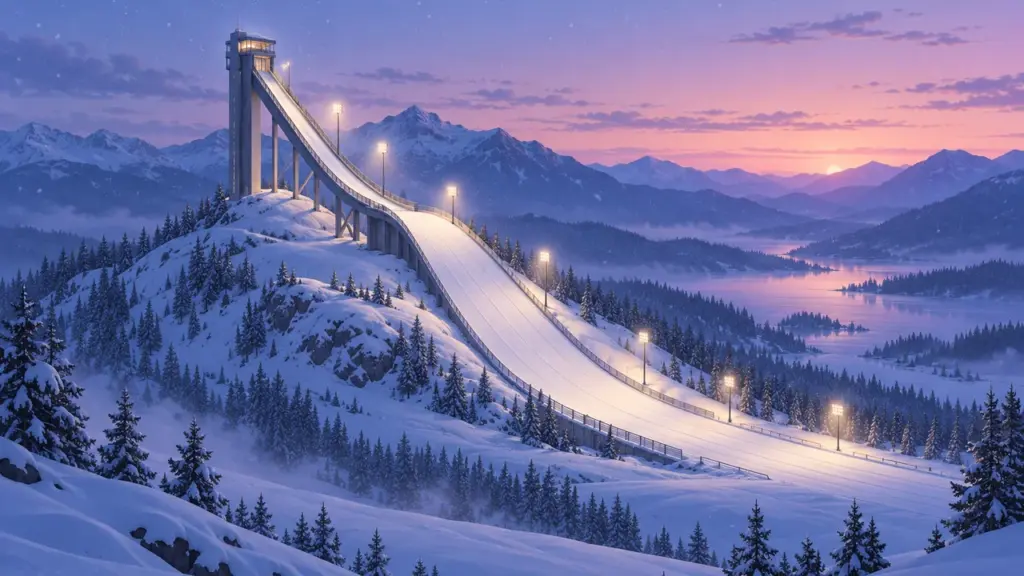
The scoring system in ski jumping is one of the more elaborate in winter sports, and at the same time one of the worst explained online. Here we stick to the rules: how a competition is built, who gets through qualification and how a result arises from distance, judges’ marks and compensation. We cover ski jumping bets, markets and the settlement of shortened competitions in the article on how to bet on ski jumping (in Polish).
When the World Cup season runs
The Ski Jumping World Cup season traditionally starts in November, usually with competitions on hills in Scandinavia, and ends in March (the exact dates of the competitions are given in the World Cup calendar). Between the start and the finish there are several dozen competitions: individual, team and mixed team, spread across hills in a dozen or so countries, including regularly in Poland.
The Four Hills Tournament – the traditional core of the season
The Four Hills Tournament is four competitions within the World Cup, not a separate event. The venues and dates are given in the calendar. The points from each of these four competitions count as normal towards the overall classification of the whole World Cup, and in addition a separate, traditional classification of the tournament itself is kept, one of the oldest and best-known trophies in the sport. The season traditionally ends in Planica in Slovenia, where the overall World Cup classification is decided. The winner of the whole series receives there the so-called Crystal Globe, a trophy awarded for the sum of points from all the individual competitions of the season.
Hills of different sizes – from small to mammoth
Not every World Cup competition takes place on the same hill, and the hill on which the event is held affects both the character of the competition and the distances achieved. Hills are described by two different numbers, which are easy to confuse. The K-point (construction point) is the distance for which the hill was designed: the historical way of naming hills, hence names such as “K-95”. HS (hill size) is the newer indicator, officially used today: the safe limit of distance at which the landing area still allows a safe stop, usually a few to a dozen or so metres further than the K-point of the same hill. Classification by size is made by HS, not by the K-point:
| Category | Size (HS) |
|---|---|
| Small | 20–49 m |
| Medium | 50–84 m |
| Normal | 85–109 m |
| Large | 110–184 m |
| Mammoth (ski flying) | 185 m and up |
The World Cup is held mainly on large hills, the Four Hills Tournament included. Ski flying, the most extreme variety of the sport, takes place only on the few mammoth hills in the world: at present there are just five. They are Vikersund in Norway (the largest hill in the world), Planica in Slovenia, Oberstdorf and Bad Mitterndorf (Kulm) in Germany and Austria, and Harrachov in the Czech Republic. It is on these five venues, and only on them, that the vast majority of the longest jumps in the history of the sport have been made.
Competitions on mammoth hills do not replace the regular calendar on large hills. They are a separate, additional part of the season, limited to a handful of weekends, because there are very few such extreme venues in the world. The biggest event of this variety of the sport is the Ski Flying World Championships, described below.
Ski flying – a more extreme variety of ski jumping
Ski flying is a separate, though closely related discipline, held only on mammoth hills, where athletes reach noticeably greater distances than on the large hills of the classic World Cup. The Ski Flying World Championships are a separate cycle from the ordinary World Championships: they are held every two years, in even-numbered years, since 1986 (earlier, in 1972–1985, they were held in a cycle of odd-numbered years, before the FIS moved them to the present rhythm). The championship competition itself consists of four rounds of jumps spread over two days, and the title is decided by the sum of points from all four rounds. This is unlike a typical World Cup competition, where only two rounds count.
The Four Hills Tournament: qualification in the KO system
The tournament has its own qualification format, different from an ordinary World Cup weekend: a system of direct KO duels. Jumpers are paired crosswise, instead of the usual split into two rounds according to places in qualification: the best from qualification faces the fiftieth directly, the second the forty-ninth, and so on. Twenty-five winners of these duels advance to the main competition, plus five so-called “lucky losers” with the best results among the losers. That makes thirty jumpers, exactly as many as normally advance to the second round of an ordinary competition.
World Championships and Olympics – a separate calendar from the World Cup
The classic World Championships in ski jumping (part of the FIS Nordic World Ski Championships, which also include cross-country skiing and Nordic combined) are held every two years, in odd-numbered years. The Winter Olympic Games, in turn, take place every four years. Both of these tournaments are entirely separate from the World Cup: medals won at the World Championships or the Olympics give no points towards the overall World Cup classification, although these competitions are often counted additionally within separate, parallel season classifications published by the FIS.
Qualification – who gets into the competition at all
Qualification is usually held the day before the competition, one jump per athlete, and cuts the field to 50 jumpers (to 40 in ski flying). According to the rules of the men’s World Cup for the 2026/27 season, all athletes must take part in qualification, and their result counts for points. A tie for the last qualifying place increases the field by the tied jumpers. An athlete who fell but jumped at least 95% of the longest jump is entitled to start in the competition in addition. If qualification is not held, or is not held on the day of the competition, the jury may order a trial round before the first round of the competition.
How a single competition looks – qualification and two rounds
Every individual competition starts with qualification, from which a limited number of athletes advance to the competition proper. In the competition itself the first round includes everyone who got through qualification, that is usually about fifty jumpers. Only the thirty best from the first round advance to the second, deciding round, in reverse order of the place held: the leader of the first round jumps last in the second. If in exceptionally bad weather the second round cannot be held, the result of the first round is the final result of the competition (FIS International Competition Rules, Book III, art. 452.2.2).
Wind compensation – how it is really calculated
Ski jumping is one of the few sports in which the scoring system formally compensates for weather conditions, rather than merely taking them into account descriptively. Wind is measured at several points along the landing slope and averaged for each jump separately. A headwind, which makes the flight easier, subtracts points from the athlete; a tailwind, which makes it harder, adds them. Every hill has its own conversion of points for each metre per second of wind, set by the organisers: for example, on one of the smaller World Cup hills (K-95/HS-108 in Hinterzarten) the conversion is 7.2 points for each m/s of wind, while at other venues this value is different, because it depends on the profile of the particular hill. So there is no single, universal formula applying across the whole World Cup – there is one mechanism, calibrated separately for each venue.
The second element is compensation for the start gate. The jury may lower or raise the gate between successive groups of athletes to balance the changing conditions. A lower gate means a lower in-run speed and, statistically, a shorter jump, so an athlete starting from a lower gate has points added, and from a higher one – subtracted. As with wind, the exact conversion, points for each centimetre of gate change, is individual to each hill and set by the FIS together with the competition jury. What the spectator perceives as the “length of the jump” therefore passes through two additional conversions in practice before it turns into the result on the board. The distance of the jump alone, without the context of conditions, does not yet tell you everything about who really won the round.
Style marks – five judges, extreme marks discarded
Besides the points for distance and the weather compensations, every jump is also assessed by five style judges, independently of one another, on a scale from 0 to 20 points, in steps of 0.5 points. They assess mainly the position in flight and the landing, the so-called telemark. The highest and the lowest of the five marks are discarded, and the sum of the three middle marks counts towards the result, up to a maximum of 60 points. This mechanism is meant to limit the influence of a single, markedly out-of-line judge on the athlete’s final result. The style assessment itself, unlike the mathematical compensations for wind and gate, nevertheless remains partly subjective by nature.
Three examples from the rules
First: a hill with the K-point at 120 m, that is in the range in which a metre is worth 1.8 points. A jump exactly to the K-point is 60 points for distance. Athlete A jumps 130 m, so he receives 60 + 10 × 1.8 = 78 points for distance, and the five style marks (17.5, 18.0, 18.0, 18.5, 19.0) give, after the extreme ones are discarded, 18.0 + 18.0 + 18.5 = 54.5. Together 132.5 points before correction. Athlete B jumps 126 m, receives 60 + 6 × 1.8 = 70.8 points for distance and 54.0 for style, together 124.8. If, after the correction for wind and gate, B has a balance of +9.0 points, his score is 133.8 and he comes ahead of A despite the shorter jump. The marks and the correction balance in this example are invented; the conversions come from the FIS rules.
Second: qualification with the longest jump of 130 m. An athlete who fell on a jump of 124 m reached more than 95% of that length (the threshold is 123.5 m), so he is entitled to start in the competition in addition, even if he did not finish in the first fifty. The field is therefore sometimes larger than 50.
Third: a competition in which the second round is cancelled because of the weather. The leader after the first round (in the example 128.0 points) is the winner of the competition, and the order of the remaining athletes corresponds to the classification after the first round.
The mixed team competition – the fourth variety of competition
Besides individual competitions and classic team competitions (teams of a single gender), the World Cup calendar also includes mixed team competitions, in which both women and men jump in one team. This is a relatively young but already regular part of the season, held in the same two-round format as ordinary team competitions.
Individual scoring place by place
Points towards the overall World Cup classification go to the thirty best athletes of a competition: the higher the place, the more points, up to a maximum of 100 for a win:
| Place | Points | Place | Points |
|---|---|---|---|
| 1. | 100 | 16. | 15 |
| 2. | 80 | 17. | 14 |
| 3. | 60 | 18. | 13 |
| 4. | 50 | 19. | 12 |
| 5. | 45 | 20. | 11 |
| 6. | 40 | 21. | 10 |
| 7. | 36 | 22. | 9 |
| 8. | 32 | 23. | 8 |
| 9. | 29 | 24. | 7 |
| 10. | 26 | 25. | 6 |
| 11. | 24 | 26. | 5 |
| 12. | 22 | 27. | 4 |
| 13. | 20 | 28. | 3 |
| 14. | 18 | 29. | 2 |
| 15. | 16 | 30. | 1 |
Team competitions – a different points scale
Besides the individual calendar, the season also includes team competitions, four jumpers to a team, with a separate, clearly higher points scale than in individual competitions:
| Place | Points |
|---|---|
| 1. | 400 |
| 2. | 350 |
| 3. | 300 |
| 4. | 250 |
| 5. | 200 |
| 6. | 150 |
| 7. | 100 |
| 8. | 50 |
An athlete builds up his points total throughout the season by summing the results from all the individual competitions held.
In a team competition each of the four athletes representing a given country jumps in both rounds, as in an individual competition. This time, however, the sum of the marks of all four jumpers counts, not the result of a single athlete. This means that the team competition rewards above all the depth of the squad: a country with one outstanding jumper and a weaker rest of the team does worse in team competitions than in individual ones, and vice versa.
Ski jumping bets
We describe the markets for a single competition and their settlement in the article on how to bet on ski jumping (in Polish). Besides these, bookmakers offer long-term picks, such as the winner of the Four Hills Tournament or of the overall season classification (the Crystal Globe). These long-term markets are usually priced even before the start of the season, in November, and with each competition held the price becomes more and more “settled”. This is a mechanism identical to that of long-term markets in football, which we describe in the guide to Champions League odds. We explain the mechanics of the margin and of how a bookmaker prices markets of this kind in general terms in the guide to the bookmaker margin (in Polish), and how the odds move even before the start of a series we describe in the article on how to read bookmaker odds. It is worth remembering that the result of a single ski jumping competition can be one of the more unpredictable in sport: wind conditions and the starting gate change during a round, so even well-priced odds from before the start of a competition can quickly go out of date when the weather on the hill changes. You will find the full list of operators holding a licence from the Minister of Finance in the list of licensed bookmakers. You can compare the ski jumping offer in our bookmaker ranking, for example in the review of Superbet.
Frequently asked questions
How many points does a win in a World Cup competition give?
100 points for first place, 80 for second, 60 for third, and then the scoring decreases down to 1 point for 30th place. We give the full place-by-place table above.
How many athletes advance to the deciding round of a competition?
Everyone who got through qualification starts in the first round, usually about fifty athletes. Only the thirty best from the first round advance to the second, deciding round, in reverse order of the place achieved.
How does the Four Hills Tournament differ from an ordinary World Cup competition?
It is not a separate event but a prestigious series of four competitions within the same World Cup, traditionally held at the turn of December and January in Oberstdorf, Garmisch-Partenkirchen, Innsbruck and Bischofshofen. The points from each of these four competitions count as normal towards the overall World Cup classification, and in addition a separate classification of the tournament itself is kept.
Where does the World Cup season traditionally end?
The ski jumping World Cup season runs from November to March, and its traditional finale is Planica in Slovenia – that is where the overall classification of the whole season is usually decided.
Do team competitions also count in the World Cup?
Yes, besides the individual competitions the calendar also includes team competitions (four jumpers to a team) with a separate, higher points scale – a maximum of 400 points for a team win.
See also: the 2026/27 ski jumping World Cup calendar with the competitions in Poland and the prize money and how to bet on ski jumping (in Polish).